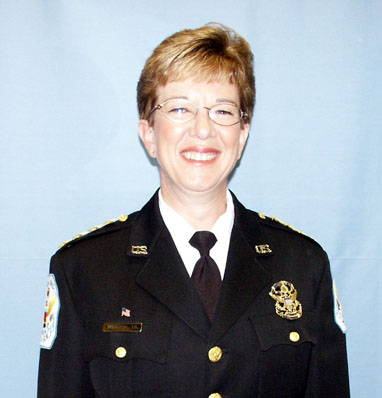
After a seven-year legal battle, Teresa Chambers has been reinstated as Chief of the U.S. Park Police. She returned to her job yesterday after an administrative panel, with new members appointed by the Obama Administration, reversed her dismissal. But recent media reports have overlooked an important element of this story -- at least for residents of the District of Columbia.
Reports uniformly cite Chambers' comments to the media regarding her concerns with the lack of staffing and budget to adequately protect national monuments following increased security demands post-9/11 as the reason for her dismissal.
But that's not quite what she said.
Chief Chambers expressed concern that due to the increased demand for officers to stand as sentries at the monuments, the U.S. Park Police would not be left with adequate officers to patrol neighborhood parks in the District. As a result, she was suspended in late 2003 and fired in mid 2004.
At the time, as a Logan Circle Advisory Neighborhood Commissioner, I was busy trying to improve the safety and look of Logan Circle Park, which, at times, was overturn with drug use and public drinking. Many of the District's circles and squares, as well as smaller "pocket parks," are federal property and primary jurisdiction for patrolling them falls to the U.S. Park Police. In fact, over the years, MPD officers have confirmed to me that they will not patrol these parks unless they happen to view illegal activity occurring.
That is why District residents should hail Teresa Chamber's return as a personal victory. Although responsible for safety and security of the National Mall, Rock Creek, Baltimore-Washington and George Washington parkways, as well as New York's Liberty Island and San Francisco's Golden Gate National Recreation Area, she kept DC's neighborhood parks a priority. She lost her job for doing so.
Welcome back, Chief Chambers.
Showing posts with label Crime. Show all posts
Tuesday, February 1, 2011
Tuesday, November 2, 2010
For an Elected Attorney General
In most states, I'd probably say that there are enough knucklehead politicians running around. But in the District, I believe it is best to elect our attorney general.
There are good reasons in favor of appoinment. When it comes to the person who is responsible for overseeing criminal prosecutions, defending the state in civil suits, enforcing government regulations, and suing on behalf of the government, its understandable to seek the best-qualified legal mind for the job. Gubernatorial (or mayoral) appointment, with Senate (or DC Council) confirmation, can provide for a rigorous selection process and may include folks that would be great for the job, but would not run for office.
On the other hand, elected Attorney Generals, "AGs", are widely considered "Aspiring Governors." They must delicately balance a need to score political points and a photo op with fair and just enforcement of the law. That's why some states stick with appointment.
But the District is not like other jurisdictions. States have a full legislature, governor (and sometimes elected lieutenant governor), county and city governments, and elected district attorneys and sherriffs. Our city of 600,000 people is essentially governed by just 14 elected officials -- the Mayor and the DC Council. The city could use more checks and balances, accountability, and oversight.
Moreover, in the Fenty Administration, we had, in a respect, the worst of both worlds. Attorney General Peter Nickles, while an extremely qualified and able attorney, also viewed his role as defending, personally and politically, the Mayor. Rather than represent "the city" and its residents, he took sides between the Mayor and the D.C. Council, the Mayor and the DC Auditor, and those who questioned the legality of the Administration's actions - whether it was donating fire trucks to the Dominican Republic or circumventing procurement rules to award lucrative park renovation contracts to friends of the mayor. The result is that we had a highly political AG that we did not elect.
Some have suggested that electing an attorney general brings us closer to Home Rule and statehood. Maybe, but that's not my reason for voting FOR the ballot initiative. It's a matter of having more checks and balances and accountability in DC government.
Putting some fire under the AG could also result in some policy changes. Is there any doubt that an elected attorney general would not stand by while youths who have committed crimes are quickly released back into the public to commit more violence? Who will be the next DYRS "ward of the state" to make headlines?
One of my neighbors received a robocall identified identified as on behalf of "black churches" asking that he vote "NO" to the ballot initiative for an elected attorney general. Those behind the robocalls are likely supporters of Vince Gray who do not want his power diminished by creating an independent attorney general. Yes, electing an attorney general will reduce the mayor's power, just as eliminating the authority of the elected school board increased the mayor's control.
In this case, the best choice is for an elected attorney general.
Wednesday, October 27, 2010
Killed Professor's Car Turns Up in Shaw With Ward of DC
It is not long since Shaw Middle School Principal Brian Betts was killed by three individuals that should have been incarcerated, but were not, because of the District's lax policies regarding youth offenders and lack of capacity to hold them.
Now, the media is reporting that a man driving the car of the American University accounting professor Sue Ann Marcum, after a brief chase with police, crashed into a lamppost three blocks from my house at the busy intersection of New Jersey and M Streets / New York Avenue NW near the I-395 tunnel. Ms. Marcum was found dead in her Glen Echo home.
Deandrew Hamlin, the driver, recently turned 18. He is a ward of the District's Department of Youth Rehabilitation Services. So far, it has been revealed that Hamlin had previous arrests for car theft and destruction of property. I expect more of his criminal record will come to light over the next several days.
According to The Examiner, "It was not immediately clear whether Hamlin had absconded from juvenile detention, or had been placed in a residential facility as part of his rehabilitation. A DYRS spokesman declined to comment on Hamlin."
As of this time, Hamlin has been charged with driving the stolen auto, but not with the burglary or murder.
Coverage: Washington Examiner, Washington Times, Washington Post
Thursday, August 5, 2010
News Round Up
![]() |
| Annie Ropeick, an intern at NPR, was randomly stabbed at 7th and H Streets NW at 9am Wednesday. Annie stands in front of a vacant building in Mount Vernon Square. Photo: NPR. Intern stabbed in Chinatown. There doesn't seem to be any news on the condition of Annie Ropeick, 20, an NPR intern who was randomly stabbed in the neck, with no warning, by what appears to be young woman with mental illness. It happened yesterday when Annie was walking to work at a busy intersection in Chinatown, just outside the PNC Bank at 7th and H Street NW. According to witnesses at the scene, given the amount of blood, they presumed her dead. Fortunately reports confirm that she made it to Howard University hospital and her family was at her side. Good samaritans acted quickly to hold the assailant, 24-year-old Melodie Brevard, and care for Annie. Annie, a Silver Spring, Maryland native, is entering her junior year as a classics and philosophy major and student journalist at Boston University. She is Executive Producer of Intern Edition at NPR, blogger, and a cappella singer. Keep her in your thoughts. UPDATE: According to Boston University's student newspaper, a family source said her injuries were non life-threatening, and that doctors expect her to make a full recovery. “She was conscious and talking the whole time,” the source said. “Basically, she’s a lucky girl.” Fenty Loses on Home Turf. Last night, Mayor Adrian Fenty has actually managed to lose a straw poll in his home Ward 4 to challenger Vince Gray. In fact, gray came within 2% of the 60% vote needed for an outright endorsement of the Ward 4 Democrats at the roudy forum. You can watch the entire forum online here. After sweeping every precinct in the city in 2006, Fenty has squandered this good will to lose straw polls in every area except Ward 2. Can he turn the momentum around as the primary approaches in just six weeks? Can't Go Home Again. Washington CityPaper reporter Lydia DePillis exposes how the city's Home Again program, which was formed to eliminate neighborhood blight, has instead perpetuated it. "The Department of Housing and Community Development is now phasing Home Again out—but many properties are still stuck in its portfolio, mired in litigation and bureaucracy, sticking neighborhoods with blight that otherwise might have been cleared up long ago. Which is, of course, exactly what the program was set up to avoid." ANC Election Season Begins. DCist reminds us that nominating petitions for Advisory Neighborhood Commissioner positions are now available. While it only takes 25 valid signatures to get on the ballot, these positions are important and can have a significant effect on the quality of life in a neighborhood. They can promote or discourage development, permit or stop more liquor stores from opening, fund beneficial and worthwhile projects or give taxpayer dollars to friends and political supporters, and demand community involvement in government policy decisions or stay silent. You can view the list of candidates who were first to pick up nominating petitions. Think about running. Make sure to cast an educated vote. A New DYRS? Think Again. For those who thought Mayor Fenty's appointment of prosecutor Robert Hildum to head the Department of Youth Rehabilitation Services would take the troubled agency in a new direction, that assessment is already looking fuzzy. The Examiner reports that among Hildum's first actions was to hire Linda K. Harllee-Harper to serve as the agency's head of internment. Harllee-Harper formerly served on the Board of Directors of Peacoholics, the organization that received millions in public funds during the Fenty Administration and has worked closely with Ron Moten, the organization's founder -- you know, the one who compared Fenty to "Jesus," was involved in the fire truck sent to the DR, was accused of paying youth to vote in a straw poll for Fenty, protested Council legislation against vote buying, and sued a Ward 8 ANC Commissioner for libel. Now Harllee-Harper will "play a pivotal role" in awarding DYRS contracts to organizations, including Peaceaholics. Taxpayers, hold onto your wallets. Free Summer Movies in Mount Vernon Triangle. Patty Yao, a native Taiwanese and contestant in the 2010 Washington Metropolitan Miss Chinese American Pageant Finals will sing live at the DC Premier of Cape No. 7 on Sunday, August 8, at 8pm at 5th and Eye Streets NW. The Taipei Economic and Cultural Representative Office in US presents this second of five free outdoor movies in the Five Eye Asian Film Series, Cape No. 7 is the highest grossing film in Taiwan's history. DC Gov Would Take Away Little Disabled Pet Chickens From Children. The Washington Post profiles a Capital Hill family that had to send their pet chickens to a farm in Virginia. "Flash is a chocolate-colored bird in that awkward stage of chickenhood, somewhere between chick and hen. Flash also has a deformed leg. Sam's sister, Maxine, 7, explains why they have to care especially for the crippled bird. 'He's smaller than the other birds because he can't feed himself so well,' she says." The family applied for a permit from the DC Health Department and built a mini-chicken coop in their backyard with the support of neighbors. All seemed to be in order until the Department declared the hens illegal, finding that their own regulations allowing chickens are superseded by a contradictory statute banning poultry and any other creatures not specifically allowed. "Sam and Maxine, meanwhile, are left with the worms to find and play with. If that's allowed." |
Monday, August 2, 2010
When Do the Kid Gloves Come Off?
The Examiner reports that a fight among "youth" under the auspices of the Department of Youth Rehabilitative Services broke out in none other than city hall itself in the presence of the Mayor Adrian Fenty and juvenile justice experts.
The throwdown, which involved three girls who were apparently receiving awards from the mayor as among the most successfully rehabilitated offenders, involved chairs, fists, and went on for several minutes before D.C. fire and rescue workers arrived at the Wilson Building to reestablish control.
An investigation by Attorney General Peter Nickles that began after three DYRS killed Shaw Middle School principal Brian Betts revealed that 71 percent of the juvenile offenders in DYRS were convicted again within two years and that youths had been disappearing for weeks at a time before the agency sought an arrest order. Thus far in 2010, at least 10 youths who were supposed to have been under the supervision of the agency have been charged with murder, and six of the agency's youth have been slain themselves.
I keep seeing the word "youth," but check the ages.
In the Wilson Building incident, police arrested Grace Ebiasah, 18, Anna Ebiasah, 20, and Deanna Morris, 19, with fighting in a public place.
In the Brian Betts' murder, the youth charged in his killing -- Sharif T. Lancaster, Alante Saunders and Deontra Q. Gray-- were all 18 years old, had lengthy criminal records, and were at large.
Many of the "youth" that are under DYRS supervision are actually not youth at all. They are often over 18 years of age, yet still get treated as if they are children. With respect to these "girls," the city does not even have a holding facility, given that New Beginnings only serves boys.
At some point, isn't it time for the city to take off the kid gloves?
Friday, July 2, 2010
Peacoholics Responds
Peacoholics has provided new details on the organization's funding and operation, which has been a growing source of controversy. At a joint meeting of the Convention Center Community Association and Mount Vernon Square Neighborhood Association, Peacoholics Executive Director Maia Shanklin Roberts answered questions posed by residents. The organizations' co-founder, Ron Moten, also participated in the community forum.
Millions in Public Funds
According to Roberts, between 2008 and 2009, Peacoholics received $3.48 million in city, federal, and private funds. Most were allocated to violence intervention programs in Wards 1, 2, 7, and 8. Their activities included operating a community center, programs at two high schools, and work at New Beginnings, the city's youth detention center. Peacoholics also performed third-party monitoring for court social services, including probation checks for 100 juveniles.
Moten: No More Earmarks
When public funding for Peacoholics was at its apex in 2008-09, the organization had a 60-member staff. Since elimination of much of its city funding, particularly after the DC Council eliminated all earmarks last year, Peacoholics has significantly downsized. It is now examining sustainability issues and considering partnerships with other organizations and sources of private funding.
In what may have been a surprise to some, Peacoholics Founder Ron Moten declared, "I believe that earmark funding should be cut, eliminated" and that there should be a competitive process to obtain government funding. Moten had led a protest with youths at the Wilson Building, covered in bandages and fake blood, after the city council eliminated earmarks. Moten's comments were directed to Council Chairman and Mayoral Candidate Vince Gray, who attended the meeting for a candidate's forum later on the agenda. Moten's comments appeared to be fueled by his frustration that despite the elimination of most earmarks, Gray allowed groups friendly with Councilmember Harry Thomas (D-Ward 5) to obtain public funds for violence intervention programs on an noncompetitive basis.
"I think it is criminal to give people money who don't do the work, who are just friends with people," said Moten.
Millions in Public Funds
Some have questioned the appropriateness of Peacoholics receiving millions in public funds during the Fenty Administration, raised concerns with a lack of government oversight, and asked questions about the organization's accountability for obtaining results.
Roberts noted a website, http://www.citystat.org/, where one can view the public funds provided by DC agencies to organizations. If you have not seen this website, it provides quite interesting information, even if not very user-friendly. The database provides the following information for city funds provided to Peacoholics, but does not provide detail as to the date or purpose of payments:
PEACEOHOLICS INC
DEPART OF YOUTH REHABILITATION SERVICES PO249009 - $659,049.00
HOUSING PRODUCTION TRUST FUND PO266784 - $600,000.00
DEPART OF YOUTH REHABILITATION SERVICES PO205572 - $583,814.00
METROPOLITAN POLICE DEPARTMENT PO231942 - $199,433.00
METROPOLITAN POLICE DEPARTMENT PO261004 - $100,000.00
DEPARTMENT OF HUMAN SERVICES PO163563 - $99,995.00
DEPARTMENT OF HUMAN SERVICES PO174329 - $83,333.30
DEPART OF YOUTH REHABILITATION SERVICES PO180444 - $74,877.00
DEPART OF YOUTH REHABILITATION SERVICES PO236656 - $68,897.30
DEPARTMENT OF HUMAN SERVICES PO206553-V2 - $62,575.90
DEPARTMENT OF HUMAN SERVICES PO236638 - $50,000.00
DEPART OF YOUTH REHABILITATION SERVICES PO194550-V2 - $36,666.70
DEPARTMENT OF HUMAN SERVICES PO200256 - $31,250.00
DEPUTY MAYOR FOR ECONOMIC DEVELOPMENT PO234771 - $15,000.00
DISTRICT OF COLUMBIA PUBLIC SCHOOLS PO217774 - $10,000.00
DEPART OF YOUTH REHABILITATION SERVICES PO168587 - $9,420.00
DEPARTMENT OF HUMAN SERVICES PO159218 - $9,420.00
DEPART OF YOUTH REHABILITATION SERVICES PO200718 - $7,333.33
Grand total: $2,701,064.53.
Moten: No More Earmarks
When public funding for Peacoholics was at its apex in 2008-09, the organization had a 60-member staff. Since elimination of much of its city funding, particularly after the DC Council eliminated all earmarks last year, Peacoholics has significantly downsized. It is now examining sustainability issues and considering partnerships with other organizations and sources of private funding.
In what may have been a surprise to some, Peacoholics Founder Ron Moten declared, "I believe that earmark funding should be cut, eliminated" and that there should be a competitive process to obtain government funding. Moten had led a protest with youths at the Wilson Building, covered in bandages and fake blood, after the city council eliminated earmarks. Moten's comments were directed to Council Chairman and Mayoral Candidate Vince Gray, who attended the meeting for a candidate's forum later on the agenda. Moten's comments appeared to be fueled by his frustration that despite the elimination of most earmarks, Gray allowed groups friendly with Councilmember Harry Thomas (D-Ward 5) to obtain public funds for violence intervention programs on an noncompetitive basis.
Roberts later responded to an assumption that most of Peacoholics funding had come from noncompetitive grants. While some of the organization's funding has come from earmarks, "most is competitively bid," she stated, resulting from the submission of proposals to government agencies.
Where the Money Goes: Peacoholics' Programs & Activities
I asked Roberts if she could be more specific in how the organization spent millions in public dollars, such as the percentage spent on staff and various programs, and whether any youth directly received cash or stipends. She noted that the activities for which Peacoholics receives government funds include third-party monitoring through the court system and its civil rights tour, in which 75-100 youths participate twice annually.
The group is also funded by the Department of Youth Rehabilitative Services (DYRS) to provide life skills training. Funds go to pay staff and overhead for acting as facilitators at New Beginnings. In addition, Peacoholics employs case managers, who are paid $45-55k per year and work with five youths. Funds also go to "exposure activities," designed to bring youths out of the violent environment in which they often feel trapped.
Roberts also explained that in schools in which it is involved, Peacoholics places six staff members who are each paid $40-47k. They work in the school from 8:30 am to 5:30 pm and then go into the community for outreach in the evenings. Peacoholic views itself as filling gaps at schools, such as providing uniforms for teams where needed.
The group's violence intervention programs, Robert's explained, involve dedicating two to three staff members to known conflicts. For instance, Roberts credited the organization for work done in Shaw with respect to gang disputes involving crews on 9th Street, 5th and O, and 7th and O. Staff are on call 24/7, go to crime scenes, and follow up.
Peacoholics typically plans large community events to bring people together, but did not have a planned event in Shaw last year upon the recommendation of MPD. Such events cost approximately $5-7k for equipment rental, such as a moon bounce and food.
During her descriptions of Peacoholics' activities, Roberts occasionally referred to "direct funds to youth" and stipends. During the discussion of the group's activities in schools, she noted that Peacoholics provides "direct support" to those youth and their families. She also mentioned the organization's use of "flex funds" go provide youths with necessities, such as clothes and shoes, as part of its DYRS-funded activities. It was unclear to me whether this may mean cash payments in some instances and how youth are selected to receive support.
Some have claimed that youths involved in Peacoholics were paid to vote in a mayoral candidates straw poll in Ward 8, an allegation was not raised or addressed at the Shaw forum. Moten is a strong supporter of Mayor Adrian Fenty. Also not discussed at the forum was the organization's involvement in a housing project in Congress Heights, which has drawn concern from nearby residents.
A Major Employer of Ex-Offenders
Three out of four Peacoholics employees at ex-offenders, stated Roberts. From Roberts' comments, this appears to serve two purposes: (1) ensure staff and at-risk youth can relate; and (2) provide a job to ex-offenders who might otherwise go back to crime. Some questioned whether providing at-risk youth with ex-offenders as mentors provides the right type of influence to move them away from crime. In response, Roberts emphasized the importance of using people for outreach who "understand and are sensitive" to the environment. Roberts also noted that their staff undergoes substantial training to provide "the more theoretical base for what they are doing" and with "hard and soft skills."
If you are "bit by a snake, the antidote comes from the snake," added Moten. "Ex-offenders who are trained properly can do the same thing" as others.
From Point A to Point B
Roberts acknowledged the limitations of the services that Peacoholics and its staff can provide. For instance, the organization is not involved in pyschological counselling, which she views as a vital service that is not being adequately provided by the District's Department of Mental Health. "Peacoholics is an organization that will take you from point A to point B," she stated. At-risk youth may then need another organization or services to go further.
"Never Heard a Good Thing," said Mendelson
Roberts was asked to respond to comments attributed to Councilmember Phil Mendelson (D-At Large) that he has never heard a good thing about the organization's work from the Metropolitan Police Department. Roberts noted that her organization is a partner with MPD on various projects and that she has recently participated in meetings with Chief Cathy Lanier and Assistant Chief Diane Groomes which do not leave her with that impression. She noted that Peacoholics always testifies at Mendelson's hearings, yet he has never met with them outside a hearing. Roberts expressed willingness to meet with Mendelson and have an ongoing dialogue, and to provide monthly reports to all funding sources.
Absconders in the Midst
Shaw resident Rickey Williams asked Roberts to explain how Peacoholics verifies that those participating in its programs "are not absconders, wanted criminals." His concern stemmed from the realization that the youth arrested in the murder of Shaw Middle School Principal Brian Betts had absconded from DYRS and participated in a retreat in suburban Maryland co-sponsored by Peacoholics just days before the killing.
Roberts noted that the organization receives permission slips from parents prior to participation in such programs, but that it "is not standard for any organization to do background checks" and that it would be counterproductive to impose such a requirement. Only when it takes youth out of state for the civil rights tour (apparently, a Maryland retreat does not qualify as out of state), the organization runs background checks to ensure participants can legally attend. Roberts also noted that the retreat was "for the entire community" and was not solely for youth in the Peacoholics program. The organization did not have an ongoing relationship, control over, or know the status of, the youth allegedly involved in the killing.
Moten added that the retreat was planned in direct and immediate response to threats of violence and retaliation in the area. "Boy scouts don't do background checks," he noted.
Wednesday, June 30, 2010
Gray Announces 3 Agencies to Fix, No More Earmarks
Tonight, DC mayoral candidate Vince Gray announced three top priorities for fixing the District's government agencies. The first target -- the Department of Employment Services -- "he's not sure what they do" beyond the summer jobs program. Next up, the position of the Deputy Mayor for Education. Gray says its time for a "more aggressive, more assertive" person in that role, one that coordinates policy between UDC, DCPS, charter schools, and other programs. Last, but not least, Gray stated that he would develop a cohesive economic development strategy that would focus on growth areas such as healthcare, educational services, and green jobs, and make the District a national leader for financial services companies.
Gray avoided providing any hint on who in the current Administration he might keep on if elected mayor. Given his current position as Chairman include oversight over DC government agencies, I asked Gray to name two agency directors or other appointees that he thought were doing a great job and two others that he thought were not quite up to par. Good try, but he's not answering, Gray responded.
Here are additional highlights of the joint forum sponsored by the Convention Center Community Association and Mount Vernon Square Neighborhood Association.
Gray on Earmarks
- Gray's elimination of earmarks was not solely due to budgetary necessity, but also a matter of policy.
- The DC Council has not followed its own earmark policy, which is supposed to limit them to $250,000 in operating funds per organization per year, up to $1 million for capital projects, and not permit repeat earmarks to an organization.
- He would have competitive grant programs available in several categories, rather than earmarks. Grants could be available for multi-year programs because some issues cannot be addressed in a single year. There would be oversight and accountability.
- Any organization that gets money from the city should have its performance evaluated by a city agency and, if it is not meeting established goals, have a remediation plan.
- Note: Ron Moten of Peacoholics, who participated, expressed frustration that Ward 5 groups friendly with Councilmember Harry Thomas have received DC funds despite elimination of earmarks, declared that he is against earmarks and for competitive grants. More on that in a follow up post.
- My view: Good plan, if it is implemented.
- In his opening remarks, Gray emphasized the need for parity between public schools and charter schools. As mayor, he would make unused or underused public facilities available for charter school and nonprofit use.
- He emphasized his support for universal pre-school. DC will be the first city in the country to guarantee seats for all 3 and 4 year olds in September 2012.
- Gray also pushed his role in creating UDC's community college, which has acquired 3 campuses.
- He will advance a holistic approach -- 0 through 24 education.
- DC has the worst special ed system in the nation. DC spent $166 million last year on special education, including $90 million to transport students to facilities outside of DC.
- My view: I appreciate Gray's focus on the entire system. I'd like the Mayor to respond to why it appears he has a poor relationship with UDC which seems to be moving forward despite him.
- As Mayor, Gray pledged to increase enforcement of the city's higher tax on vacant property by hiring more DCRA staff. These jobs pay for themselves, he said. He did not get into details about the vacant property law, but noted that the Council had finally defined "vacant" v. "blighted."
- My view: Great, but is this an empty campaign promise targeted to address an area of concern for Shaw residents? What was Gray's position on taking away and re-instituting the vacant property tax, and on what it should cover or not cover?
"We have bikes. We have segways. We have walking.... that's been around for decades."
- The purpose of juvenile justice is rehabilitation.
- New Beginnings, the JV detention center, is overcrowded and needs additional beds.
- Did not respond to the concern expressed by judges that they lack authority to sentence juveniles, which the city can let out at will.
- Acknowledged that some violent offenders are let out too soon.
- The city needs to invest more in the community placement system if this is to be an alternative to incarceration.
- Does not support the proposed "civil injunctions" as a means to curb gang violence because they will result in racial profiling and pull in people who are not criminals.
- Would push for more community policing. According to Gray (citing an MPD report), only 300 of 4,000 officers are involved in community policing.
- My view: I heard him provide a stronger view on JV justice's failure at the Ward 3 Democrats forum. It's broken. Community policing is a nice buzz word, but it's not quite tangible.
- Advisory Neighborhood Commissioner Mike Bernardo (ANC 2F) expressed the communities frustration with the slow pace of economic development on Ninth Street NW. A Shaw resident noted her concern that the owner of a property in Shaw had opted to develop a group house rather than the initially planned condominium due to zoning restrictions.
- Gray proposed more "small area neighborhood plans," such as that developed for Chinatown, as the answer. Since the summer of 2008, Gray noted that the Office of Planning, which falls under his oversight, had developed 15 small area plans that reflect what the community would like to see in their neighborhood.
- My view: I'm not sure how realistic developing such plans would be and, as I expressed in a later question on the Bundy School, plans aren't worth a dime if they are not followed or ignored.
"I thought they were high when they did [the Pennsylvania Avenue bike lanes]. They are really ludicrous."
- Gray doesn't bike, but he supports bike riding and encourages it as energy efficient.
- Reserved bike lanes in some areas of the city (i.e. 9th Street NW) back of traffic. In other areas, the lack of bike lanes have the same result. The lanes do not seem well planned. "I'm not sure we have figured out how to do it yet," said Gray.
- Pennsylvania Avenue lanes are particularly dangerous.
- Supports transit-oriented development around metro stations.
- My view: I didn't get the impression that installing more bike lanes would be high on Gray's priority list.
"I'm not suggesting blame on either side."
- Gray acknowledged that the city should enforce the law when drivers block crosswalks, hydrants, or other cars on Sundays.
- He'll work with the community and churches to solve the problem.
- My view: Ironic that Gray makes a stink about how Maryland and Virginia residents don't have to pay DC taxes, but then suggests out-of-state residents who ignore DC law have equally valid concerns with DC residents who have legitimate safety and quality-of-life issues.
- Took issue with the Mayor's reallocating the money from cleaning up the Anacostia, as designated, to regular street cleaning purposes on the purported rationale that refuse blows into the river.
- The Council has redirected the money collected from the tax back to river cleanup.
- My view: Good.
"Get a new Mayor, one that is more collaborative."
- Given his support for community planning as well as his support for offering vacant DC properties to nonprofits, I asked Gray how he would have addressed the Bundy School as Mayor. (The Bundy School, located on the 400 Block of O Street NW) is slated for residential and recreational use in the District's Comprehensive Plan, but was given to Safe Shores, a child welfare agency/nonprofit partnership).
- Gray responded that the city should stick with the plan and there should be no surprises.
- My view: Gray wasn't aware of the situation. I agree that the city should have stuck to the Comprehensive Plan, and engaged the community at an early stage if it was going to go in another direction.
Monday, June 21, 2010
A World Class Riot
At the Mayoral Forum in Ward 3 on June 11, Mayor Adrian Fenty called New Beginnings, the city's youth detention center a "world class facility." Last night, WUSA-9 reported a "riot situation" in which the juveniles refused to enter their bedrooms and fought with staff. A shift supervisor who responded had his nose broken. MPD arrived to find the youths wandering through the facility at will while others were on the roof. The good news.... apparently no one escaped this time. According to the report:
Union officials say the facility meant to house 60 youngsters between the ages of 15-20 currently holds 70 and staffers are unable to safely supervise their charges, especially because of the more open nature of the structure's design. "It's been open season on staffers, they are being continually assaulted by the and this needs to come to a stop" concluded williams. "The juveniles need to be taught a lesson, they continually assault our officers , that's been the status quo"In somewhat related news, the Washington Post includes a report today on the Peacoholics and the millions of dollars it has received during the Fenty Administration. There's not much new in this article, but it does document that the group received at least $1.5 million in noncompetitively bid city contracts in 2008 and $5.1 million in taxpayer funds from a variety of sources in 2009 (including $4.4 million to build a group home in Congress Heights). Those figures apparently do not include $3.6 million ($1.5 in 2009) in contracts from the Youth Investment Trust Corp., which is largely funded with city money distributed by a board appointed by the mayor, or $500,000 from the Justice Grants Administration, another quasi-city agency, awarded in October 2009 for the organization to help run prisoner reentry programs. The article questions whether by taking a very active role in supporting Fenty and opposing Gray, Peacoholics may jeopardize its 501(c)(3) status. I've discussed my concerns with Peacoholics before and had a chance to discuss them in person with co-founder Ron Moten one month ago. Both Peacoholics and Chairman Gray are scheduled to appear at the next Convention Center Community Association meeting on June 29. If past meetings with Peacoholics are prologue, expect fireworks.
Saturday, May 15, 2010
What Does $8 Million in City Funds Buy?
The Washington Post reports today that Peacoholics co-founder Ron Moten has established an anti-Vince Gray website, http:/ / vincegray.info, aka "The Gray Files." The website attempts to cast a cloud over the current Council Chairman and mayoral candidate's ethics and service.
[UPDATE 5/17]: Dorothy Brizill reports in The Mail that Moten and Peacoholics cofounder Juahar Abraham "brought a large number of young people" to the Ward 8 Democrats Mayoral Election Straw Poll held Saturday. "Although most of these young people were not registered voters prior to the forum, the insisted on being allowed to register at the forum and to cast challenged ballots. Outside the church, the young people bragged about how they had been paid $100 to attend the forum." In the initial tabulation, Gray received 59 votes to Fenty's 49. After the challenged ballots were added, the result flipped to Fenty 69, Gray 61.
Peacoholics reportedly received $8 million from the DC government during the Fenty Administration, even more than the $4.5 million documented here. The DC Council, chaired by Gray, finally cut off the faucet (spurred by an investigation related to Marion Barry's earmarks to organizations that he set up and to a girlfriend). That ultimately led to a downsizing of Peacoholics. Ah, dirty politics at its worst.
Thursday, May 13, 2010
Judicial Confusion: Is JV Justice System Broken?
In an interview with Mark Segraves of WTOP [Audio / Article], Chief Judge Lee Satterfield of the D.C. Superior Court dismissed legislative efforts to form a commission to consider an overhaul of the District's juvenile justice system as political and unwarranted.
At a community forum in March, I asked the Chief Judge "from your perspective as judges on the bench . . . where do you see there being weaknesses in DC in prosecuting criminals?"
His answer: "The police officers do a tremendous job.... and the prosecutors as well... it would be good for the District to have its own crime lab, but right now the District has the best crime lab in the country and that is the FBI.... so its not that.... I think we have plenty of good laws...." In other words, he mentioned several areas that he felt worked well. But the one area he mentioned where he felt there were issues that needed to be addressed was the city's juvenile justice system.
When later asked about the lack of capacity to hold juveniles in custody by ANC 2F Commissioner Michael Bernardo, Judge Satterfield expanded. In addition to noting the extraordinary lack of capacity at the District's sole holding facility for convicted boys (and no holding facility for girls), Judge Satterfield emphasized the judiciary's inability, under current law, to sentence youth criminals (this is left entirely to the city)
Has Judge Satterfield done an about face? No, it doesn't appear so.
In the interview, Judge Satterfield maintains that judges need authority to sentence youths. He acknowledges that the number of complaints filed in his court against juveniles has increased a whopping 67% since 2003.
D.C. Superior Court District Family Court Judge William Jackson, who also spoke on the program, recognized that four percent of the 1,800 or so teens that are out on parole and under court supervision are "unaccounted for at any given time, and many do commit more crimes." That's about 72 offenders, some of which may have commited violent crimes, missing. The Department of Youth Rehabilitative Services oversees about 920 juvenile offenders. About 80 of those who are supposed to be under DYRS supervision are missing. In other words, there are about 150 youth offenders no where to be found by the court or city government. Apparently, this is a marked improvement from 2003 when as many as 1 in 4 JV offenders were unaccounted for.
Judge Satterfield notes a continuing concern, which he has repeatedly expressed to others in the city, that "there are not enough beds." The city's sole facility for housing youths convicted of crimes warranting imprisonment only can hold 60 individuals. When the facility is out of room -- what happens? Since judges do not have the authority to sentence juveniles to keep them in custody for any set period, the city can release them at any time. So the city has two options when the sign outside "New Beginnings" reads "No Rooms Available." Either a juvenile who has committed a violent or other very serious crime (or string of crimes) is given early release to make room for someone new or a youth who really should be held in custody is permitted to remain on the streets in parental custody or a group home.
To sum up -- record number of juvenile filings, no authority of the court to sentence offenders to keep them in custody, a lack of capacity to hold any more than 60 youth offenders leading to a revolving door in the city's juvenile holding facility, and about 150 teenagers at-large at any given time who are likely to commit more crimes.
Sounds like an area ripe for reform, if not yet to the level of a crisis.
Why is Chief Judge Satterfield resistant to forming an independent commission to investigate the District's juvenile justice system and recommend improvements?
At a community forum in March, I asked the Chief Judge "from your perspective as judges on the bench . . . where do you see there being weaknesses in DC in prosecuting criminals?"
His answer: "The police officers do a tremendous job.... and the prosecutors as well... it would be good for the District to have its own crime lab, but right now the District has the best crime lab in the country and that is the FBI.... so its not that.... I think we have plenty of good laws...." In other words, he mentioned several areas that he felt worked well. But the one area he mentioned where he felt there were issues that needed to be addressed was the city's juvenile justice system.
When later asked about the lack of capacity to hold juveniles in custody by ANC 2F Commissioner Michael Bernardo, Judge Satterfield expanded. In addition to noting the extraordinary lack of capacity at the District's sole holding facility for convicted boys (and no holding facility for girls), Judge Satterfield emphasized the judiciary's inability, under current law, to sentence youth criminals (this is left entirely to the city)
The thing you need to know about the juvenile justice system that is a little bit different in our city than in others ... our role as a judge, and this is something the Council can work on if they choose to, are to, when I have a youth in front of me that has committed an offense, I can can either put them on probation or commit them. So if I have a youth who committed murder ... I can't say you are going to be incarcerated for this period of time. It's up to the city to decide whether you stay into jail or you go out of jail. So they can release that individual that very day if they want....You don't think the youth that come in front of us are aware that we have this type of system? So they can control whether or not they stay overcrowded at New Beginnings or not by just doing a release if necessary when they want to. We have no control over that aspect.That was even before the recent string of shootings and murders involving youth absconders.
Has Judge Satterfield done an about face? No, it doesn't appear so.
In the interview, Judge Satterfield maintains that judges need authority to sentence youths. He acknowledges that the number of complaints filed in his court against juveniles has increased a whopping 67% since 2003.
D.C. Superior Court District Family Court Judge William Jackson, who also spoke on the program, recognized that four percent of the 1,800 or so teens that are out on parole and under court supervision are "unaccounted for at any given time, and many do commit more crimes." That's about 72 offenders, some of which may have commited violent crimes, missing. The Department of Youth Rehabilitative Services oversees about 920 juvenile offenders. About 80 of those who are supposed to be under DYRS supervision are missing. In other words, there are about 150 youth offenders no where to be found by the court or city government. Apparently, this is a marked improvement from 2003 when as many as 1 in 4 JV offenders were unaccounted for.
Judge Satterfield notes a continuing concern, which he has repeatedly expressed to others in the city, that "there are not enough beds." The city's sole facility for housing youths convicted of crimes warranting imprisonment only can hold 60 individuals. When the facility is out of room -- what happens? Since judges do not have the authority to sentence juveniles to keep them in custody for any set period, the city can release them at any time. So the city has two options when the sign outside "New Beginnings" reads "No Rooms Available." Either a juvenile who has committed a violent or other very serious crime (or string of crimes) is given early release to make room for someone new or a youth who really should be held in custody is permitted to remain on the streets in parental custody or a group home.
To sum up -- record number of juvenile filings, no authority of the court to sentence offenders to keep them in custody, a lack of capacity to hold any more than 60 youth offenders leading to a revolving door in the city's juvenile holding facility, and about 150 teenagers at-large at any given time who are likely to commit more crimes.
Sounds like an area ripe for reform, if not yet to the level of a crisis.
Why is Chief Judge Satterfield resistant to forming an independent commission to investigate the District's juvenile justice system and recommend improvements?
Friday, May 7, 2010
Betts Suspects at Peacoholics Retreat 5 Days Before Murder
Peacoholics are the talk of the town again, linking up several recent issues on this blog -- the murder of Shaw SMS Principal Brian Betts, the urgent need for comprehensive reform of the District's juvenile justice system, and the millions in city dollars given to Peacoholics on a no-bid basis without any demonstrated results or accountability.
The latest piece - the three at-large suspects in Betts' murder had attended a youth retreat in suburban Maryland sponsored by the Peacoholics just 5 days before the murder. From the Washington Post:
According to the Washington CityPaper, Peaceoholics co-founder Ron Moten denies allegations that his nonprofit group harbored three suspects.
Shaw residents posted their reactions on a neighborhood listserve:
The latest piece - the three at-large suspects in Betts' murder had attended a youth retreat in suburban Maryland sponsored by the Peacoholics just 5 days before the murder. From the Washington Post:
All attended at least part of a retreat in Southern Maryland last month sponsored by Peaceoholics, a District-based nonprofit that works with at-risk youths.[UPDATE 1:20 p.m.: And now this from Loose Lips:
Ronald Moten, the group's cofounder, said that all three arrived April 10 and participated in group discussions about violence.
Moten said that they seemed nice and that he was particularly impressed with Lancaster. "He voluntarily cleaned the whole compound," Moten said.
The three left that night. After the retreat, two of them attended a follow-up session. "We haven't seen them since," Moten said. Five days after the retreat, Betts was dead.
Police Union Chief Kristopher Baumann e-mailed LL to say that Moten's group is actually being paid by the District to find absconders and bring them back to DYRS. Moten testified on the subject at a hearing last year. Baumann writes:
"On June 10, 2009, Well’s committee held a hearing on DYRS. It was unbelievable. (I know watching old hearings can be a drag, but it is worth it.) Testifying in support of Schiraldi and DYRS were several non-profit groups (Peaceaholics, Concerned Men, etc) that testified that they were receiving “grants” from DYRS to go track down absconders and talk them in to returning to DYRS. Of course, they had no statistics (e.g., number of absconders returned, etc.) but that was what DYRS was paying them to do (they also apparently have office space at DYRS). These are essentially earmarks, but are being done by the Executive so they are called grants, with no oversight, no reports required. Worse they are giving money to groups to do the work the police should be doing (the word on the street is that DYRS did not want the MPD knowing how many absconders existed because it might be leaked and would not match the numbers they have been reporting)."]
According to the Washington CityPaper, Peaceoholics co-founder Ron Moten denies allegations that his nonprofit group harbored three suspects.
Shaw residents posted their reactions on a neighborhood listserve:
"I don't know why [DYRS] can't lock some GPS anklets on them; not doing so is like granting them a leave of absence to go out and commit violence after they finish their training with DRYS coaches. Twenty-eight young former offenders [representing the 7% of the 400 youth under DYRS supervision that are typically absconders] can probably execute all the violent crime in the City for one week."
"Can we get your commitment that you will look into this "most serious" accusation? I know both of you have been supporters of the peaceaholics in the past but have begun to see some of the same issues that many in the community see with this group. I will admit that Mr. Moten was a most impressive salesman the last time I saw him but this is a serious problem! I am all for trying to get kids into programs that get them off the streets and into jobs but this is one in a long list of problems with this group." (Email to Councilmembers Evans and Graham)
"We now have numerous deaths in our city, [a] SE shooting where 4 died, and up to 10 were injured, a recent robbery and shooting death of a beloved teacher/ principal, and yesterday a shooting on a metro bus. All by juveniles that had a long list of offenses and by standard in nearly every other city in America they would have been behind bars. Yet in our city, they are running lose on our streets, endangering the lives of countless citizens, youth, visitors and anyone that might by change cross their path. When will we see a responsible elected body of councilmembers, and a mayor that steps up and does something? When will the excuses stop and action begin to replace the do-nothing approach of the current madness?"
Thursday, May 6, 2010
Let's Give Some More Kids a New Beginning
Look, I'm not a fan of taking every kid who commits a minor offense, locking him (or her) up, and throwing away the key, but violent offenders should not be on the street. If you wonder why the shootings, attacks involving juveniles, and yes, murders, are happening, look no further than an article in today's Washington Post.
Here's an excerpt:
The Washington Post article is not a revelation. The Chief Judge of the D.C. Superior Court pointed out these problems as among the most serious facing the city at a forum in March, months before Mr. Betts's murder. At that forum, I also raised the apparent lack of reliable statistics on what happens after an arrest -- convictions and sentencing -- both on the part of the court and the city, which is again evident from this article.
The Mayor or DC Council should immediately establish a task force to comprehensively address juvenile justice in the District.
This task force should include representatives of the executive branch including DYRS, the Council, the judiciary, and the community. It should consider best practices of states, municipalities, and the federal government; develop legislative and administrative reforms; determine what additional resources are needed (i.e. increased holding capacity for youth offenders, additional officers to track down absconders); and consider what mechanisms should be implemented to track results. The Task Force should hold a series of open hearings, circulate a preliminary report within six months, and present a final report recommending tangible actions that our officials should take within nine months.
Here's an excerpt:
Like [those the three 18-year-olds who murdered Shaw Middle School Principal Brian Betts], most of those under [the Department of Youth and Rehabilitative Services (DYRS)] supervision are not in detention centers. [S]ome live in group homes, which are staffed but not locked. Others . . . live at home and are supervised in the community. Only about 60 of the youths committed to DYRS live at its New Beginnings, and 160 or so with severe behavioral issues live in out-of-state facilities better able to deal with specialized needs.
When a juvenile is placed on probation . . . he would report to Court Social Services. A spokeswoman for D.C. Superior Court said the number of juveniles under the agency's supervision was not available. Other information about the agency, such as how many of its juveniles have been arrested in the past year and how many have absconded from custody, was also said to be unavailable.You heard it folks, the city government, which is in charge of determining whether a youth is locked up, released to a group home, or placed on probation (not the court) only has room to hold 60 youth offenders in custody. Some are not held because there simply is no room. Those who escape, walk out of an unlocked group facility, or stop showing up for hearings only have to worry about 3 individuals tracking them down, unless they happen to run into a police officer when committing their next crime. The current state of affairs is unacceptable. Period.
Court Social Services, like DYRS, has a unit that tries to find youths who have walked away from a group home or who have stopped showing up for drug tests or other appointments.
But with dozens of juvenile absconders at any given time, DYRS does not have the resources to mount an intense search for every one of them. The agency's absconder unit is made up of three people, so it relies on police officers, who have to worry not only about scores of juveniles but also thousands of adults wanted by the courts.
The Washington Post article is not a revelation. The Chief Judge of the D.C. Superior Court pointed out these problems as among the most serious facing the city at a forum in March, months before Mr. Betts's murder. At that forum, I also raised the apparent lack of reliable statistics on what happens after an arrest -- convictions and sentencing -- both on the part of the court and the city, which is again evident from this article.
The Mayor or DC Council should immediately establish a task force to comprehensively address juvenile justice in the District.
This task force should include representatives of the executive branch including DYRS, the Council, the judiciary, and the community. It should consider best practices of states, municipalities, and the federal government; develop legislative and administrative reforms; determine what additional resources are needed (i.e. increased holding capacity for youth offenders, additional officers to track down absconders); and consider what mechanisms should be implemented to track results. The Task Force should hold a series of open hearings, circulate a preliminary report within six months, and present a final report recommending tangible actions that our officials should take within nine months.
Thursday, April 29, 2010
Latest Peacoholics Drama
Housing Complex has an interesting piece today about the latest in what seems to be a neverending drama about the Peacoholics. It involves their building a 13-unit transitional living facility for at-risk youth, apparently with funds stemming from the D.C. Department of Housing and Community Development in Ward 8's Congress Heights.
The story is the same we've heard again and again about Peacoholics. It's not that people object to their mission - in fact, they'd find a lot of support from just about everyone. It's not even NIMBYism. Rather, the issues with Peacoholics come down to this every single time:
Confrontational approach. Peacoholics and its leaders seem to take an adversarial, confrontational, and defensive approach to addresssing the community. Although any other group involved in a development project would come before the Advisory Neighborhood Commission and explain the project to residents, and seek their support at the get-go (the project across the street from theirs indeed did so), Peacoholics addressed the community only after controversy erupted and was summoned by the ANC. As described in the article, they sat in the back of the ANC meeting, didn't introduce themselves, then lashed out when questioned about their finances. Ultimately, they accused an ANC Commissioner of seeking bribes from them and sued her for defamation. I've witnessed a similar meeting in Shaw.
Lack of transparency and accountability. Peacoholics seem to receive a lot of government funds (fire engine transfer to the DR aside) [UPDATE: Wow, Congress Heights on the Rise has posted documents residents received in response to a FOIA request. They show that Peacoholics received $1.3 million from the Department of Youth Rehabilitative Services in FY 2008-2009, $4.5 million from the Housing Production Trust Fund in FY 2007-2009, $300k from the Public Safety and Justice budget in FY 2007-2008, and $50k from the Department of Human Services in FY 2008.] Even after the Council cut off millions in earmarks, here it is again receiving public money. But even that is not a problem in itself. While the group declares matter of factly that they have stopped killings in [insert your neighborhood], it will not produce any reports, statistics, etc. that provide a description of precisely what it does, how many youth it serves and in what capacity, a budget/financial statement showing how it spends its money, its accomplishments... results. The lack of accountability, particularly when public money is at issue, raises concern.
It's really a shame. Providing support in the form of mentoring and job placement is important for at-risk youths, as is showing them there are alternatives to the cycle of gang violence and retaliation. Nonprofit groups such as Peacoholics have a role to play that may not be adequately filled by MPD in enforcing the law and government agencies in providing social services. But the approach, the management, the seeming contempt for anyone who asks questions undermines this organization's effectiveness.
Saturday, April 24, 2010
Franklin, Betts, Shootings, and more...
What's the Status of the Franklin School RFP? Based on a statement made at the April 7 Advisory Neighborhood Commission 2F meeting, which had supported Yu Ying Public Charter School's proposal for use of the Franklin School as a Chinese language immersion program, there is speculation the District has again rejected the idea. At the meeting, ANC2F Chairman Charles Reed reported that the Deputy Mayor's office commented that there was "a glitch" in the Yu Ying proposal. That would leave the boutique hotel option, which includes a restaurant and culinary school of some sort. No award of the RFP yet. The Coalition for Franklin School continues to push for an educational use for the building, as discussed in The Intowner.
Brian Betts. According to Friday's Washington Post, police believe that at least two people were involved in the beloved Shaw principal's shooting. Also read Petula Dvorak's column exploring the impact of Betts' death on the many young lives in which he played an important part. The DC Agenda also has a story on Betts - please refrain from the gay conspiracy theories, really. There will be a memorial service for the public at Strathmore Hall (5301 Tuckerman Lane, North Bethesda, Maryland) on Saturday, May 1 (time TBD). There will also be a school tribute for students, parents and staff at Shaw at Garnett-Patterson on Thursday, April 29.
Shootings are Back. This past Monday (4/19), we had two shootings in Shaw around the area of 5th/6th and N NW at about 8:30pm and then again at about 9:30pm. [UPDATE: The bullets keep flying. There was another shooting on Saturday, 4/24 at six in the afternoon around the same location.] The warm weather is here. I am told that MPD recovered a discarded gun after the first shooting and questioned some potential suspects. Fortunately, no one was hit. There's a crime camera right above the site. Hopefully, MPD will be able to make an arrest. Amazing how secure the neighborhood was during the Nuke summit.
DC Refund Comes in Last. My wife and I filed our federal, District, and Maryland tax returns at the same time -- in late February or early March. We received our tax refunds from the federal government and Maryland about one month ago. The District's has yet to arrive.
Friday, April 16, 2010
Loss of Brian Betts
I was saddened to learn this morning of the tragic death of the principal of Shaw Middle School, Brian Betts.
When I first met Brian, he had only been in his new position for a few weeks. It was summer and he made time to meet with me to discuss the challenges he faced and the future of the school even as he interviewed a stream of candidates for teacher positions at the school.
What impressed me most about Brian was his optimism. It was different, refreshing, and real, not contrived. He firmly believed that by placing confidence in his students, developing relationships with parents and the community, and through hard working teachers, even students facing the greatest challenges could and would succeed. He set high goals for himself and his team. His devotion was appreciated by all.
My thoughts go out to his family, colleagues at DCPS and Montgomery County, and to his students.
I hope that the police and media will soon provide us with more information on the suspicious circumstances surrounding his death. Detectives are asking anyone with information regarding the whereabouts of the victim's dark blue Nissan Xterra blue 2007 Nissan Xterra (MD plate 562M222) to call the police non-emergency number of (301) 279-8000. Anyone with other information pertaining to this death is asked to call homicide detectives at 240-773-5070. Callers may remain anonymous.
Friday, March 5, 2010
Chief Judge Speaks
Last night, the Mount Vernon Square Neighborhood Association, Convention Center Community Association, and Blagden Alley Association co-hosted a public forum with the Chief Judge of the D.C. Superior Court, Lee Satterfield, who was joined by his colleague, Judge Ronna Beck. Here are five points and observations that I found particularly interesting.
1. While D.C. Superior Court judges are appointed by the President, there is a misconception that some (or most) are not from the District. Comments from Councilmember Jack Evans earlier this week suggested that D.C. Superior Court Judges are from places like California. According to Chief Judge Satterfield and Judge Beck, that just is not true. There is a residency requirement for D.C. Superior Court judges -- all must live in D.C. Most, including Chief Judge Satterfield, are from the District and have spent their entire careers practicing law here. In addition, the selection process, which relies on the recommendations of a nominating committee whose members are appointed by the President, Mayor, DC Council Chair, and Bar (known as merit selection) is among the best systems for appointing judges (nonpartisan, qualifications oriented, not subject to campaign fundraising). That does not change my opinion that, as a matter of principle and home rule, the District, not the President, should select its judges and have more control over its criminal justice system, but it does provide some degree of comfort.
2. The District has little sense of what occurs in its own criminal justice system from a 30,000 foot perspective. At a meeting that included Councilmembers Mendelson and Evans several months ago, there was frustration that the Council (and DC citizens) have no way of knowing what happens after the arrest. How many of say gun cases were no papered, pleaded down, went to trial, resulted in acquittal or resulted in convictions? How often are DC's strong mandatory minimums actually applied? What is the average sentence for gun possession (i.e. is there actually a revolving door)? I was disappointed to find that the judges also appeared to lack hard numbers. The Chief Judges' law clerk may follow up with me with what statistical information is available, but this type of information should be readily available to the public, members of the judiciary, and legislators. There is a substantial amount of such information available for the federal courts through the U.S. Department of Justice's Bureau of Justice Statistics. And, note to our Councilmembers, right now, BJS is giving out money to the states to develop their own statistics (applications are due March 19).
3. If there is one area in which the judges felt the District's criminal justice system could improve, it is in juvenile justice. Some interesting facts. D.C. Superior Court judges have no role in sentencing JV offenders - it is up to the District government and JV's know it. The District's JV facility is too small and overcrowded, which may result in early releases when filled past capacity. While there is a JV facility for boys, there is no facility for girls. Judge Satterfield suggested the need for a larger JV facility with more educational programming.
4. The District's criminal laws are quite strict. With the exception of possession of an unlicensed firearm (pure possession, no crime associated), most gun and other violence crimes are subject to mandatory minimums of 5 years for the first offense, 10 for the second offense. Some are significantly higher, such as15 years for armed carkjacking. Judge Beck noted that the mandatory minimums are a useful tool for prosecutors in reaching plea agreements. That said, there are also many cases in which defendants proceed to trial and the judges do in fact impose the full sentence as required by law. Judge Beck also noted that the negative aspect of mandatory minimums is that it eliminates judicial discretion and there are some situations in which they can be viewed as too harsh.
5. The District has no control over those who it puts in prison. The District closed Lorton Correctional Complex in November 2001, scattering its inmates among federal prisons across the country. While the District saved money in making this move (tranferring the expense to the federal government), there is also a downside. The District has no role in the rehabilitation, training, or education of DC residents who are sent to prison. They may come back worse than they went in. D.C. residents who are sent to prison are effectively sent to Siberia. Being cut off from their families may cause further tears in the District's social fabric.
Sunday, January 24, 2010
Vacant or Blighted?
The DC Council is holding a hearing on two vacant/blighted property bills this Wednesday. The hearing will be held at 2pm in room 412 of the Wilson Building at 14th and Pennsylvania Avenue NW. The Hearing Notice recognizes:
The higher tax on vacant properties had the desired effect of moving many longstanding vacant properties into productive use. Since 2006, over 1,000 formerly vacant properties have become occupied. However, as the economy entered a prolonged recession, the vacant property tax began to affect more and more property owners, many who had simply run into hard times due to the economy....
Last year, the D.C. Council eliminated the vacant property tax - a result of backlash from the same Councilmembers doubling the tax from $5 to $10, the Department of Consumer and Regulatory Affairs more consistent enforcement of the law, the occasional innocent owner unfairly getting hit with the higher tax, and the recession (and its impact on developers with properties in limbo). Instead, the Council kept a registration system for vacant property and applied a higher tax only to "blighted properties." Due to confusion in the new law as to how the old vacant property registration system and new "blighted" property tax work together, the Council will consider these two competing proposals.
Here is my understanding of the two bills:
- B18-546 [PDF]: Introduced by Councilmember Muriel Bowser (D-Ward 4), it would keep the vacant property registration system, eliminate the exemptions (which only eliminate the need to pay a nominal registration fee), allow for an upward sliding scale for registration fee depending on amount of time property is vacant, simplify the citation issuance process, and require property insurance for vacant properties.
- B18-448 [PDF], introduced by Councilmember Jack Evans, would eliminate the remaining vacant property registration system altogether and focus only on blighted determination. This bill does not appear to be subject to the Wednesday hearing. (Note: The hearing notice refers to B18-407, but this appears to be a misprint)
Ideally, the Council should return to something closer to the prior vacant property tax system. Here are seven reasons why:
- Subjecting only "blighted" and not vacant properties to a higher tax fails to recognize that even vacant properties that are in the best of condition impose additional costs on the surrounding community. The neighbors are often the ones that pick up the trash that inevitably accumulates, shovels the snow, and calls in or paint over graffiti. Blocks with vacant property are less safe because there are less eyes on the street to report crime.
- It is much easier to determine whether a property is vacant (objective standard - is there a lease, utilities running?) than whether a property is "blighted" (very subjective - one person's blight may be another person's palace). DCRA/OTR can expect appeals and lawsuits when it attempts to impose the tax on blighted properties;
- Some properties may be judged as not meeting the "blighted" standard because the neighbors, not the owners, addressed problems -- i.e. cut overgrown grass, removed graffiti, and secured the property. Why should the owner benefit through reduced taxes?;
- What will happen when a property is "blighted" because it is a nuisance for months or years and when threatened with a higher tax, the owner nominally fixes it up to avoid the tax (i.e. picks up the trash and throws on a coat of paint) -- this would be an ongoing cycle;
- The blighted property law applies only to "improved properties" (vacant houses or stores) and not to vacant lots. Why should an overgrown, trashed vacant lot not be subject to the the higher tax while an overgrown, trashed lot that has an empty building on it get the tax?;
- Under current law, if a historic property is blighted and allowed to collapse through neglect, the owner would be rewarded because he or she would no longer subject to the blighted property tax; and
- Why, oh why, would the Council give absentee property owners a $48.9 million tax break when the city is struggling with a budget shortfall and cutting valuable services?
Exceptions to the vacant property tax should apply only to specific circumstances in which there is unfairness. For instance, similar to jury duty, a person who is serving in the military oversees or in a nursing home should be exempted from the higher tax. There should be no nonsense with property owners being able to avoid the tax by periodically pretending their property is for sale or obtaining permits for minor work on the property.
Finally, it is important that the city restore application of the higher tax to vacant lots, in addition to vacant buildings.
Residents should testify on Wednesday on their experiences with vacant property and the importance of providing effective incentives for absentee property owners to put properties back into productive use.
Thursday, December 17, 2009
Latest Crime Bill - What it Includes...
On Tuesday, Councilmembers Jim Graham (D-Ward 1) and Jack Evans (D-Ward 2) introduced the “Neighborhood and Victims Rights Amendment Act of 2009" [PDF]. The legislation:
In the District, which has about four times as much violent crime as New York City, it is not uncommon for individuals to be arrested ten, fifteen, even twenty times for serious offenses, such as gun possession, robbery, burglary, car theft, possession of drugs with intent to distribute, and, even murder, and nevertheless remain on the street.
Councilmember Mendelson, who chairs the Council's Committee on Public Safety and Judiciary, believes that the city needs closer study as to the reasons behind this "revolving door." How much of this situation stems from "no-papering" due to lack of evidence or other factors, plea bargains, court rulings, jury verdicts, or sentencing? How much accountablility lies with police officers, detectives, prosecutors, and judges? How much lies with weaknesses in the District's laws?
Overall, the bill appears to be a positive step forward. There are some legitimate questions such as how would the court determine a defendant is a "member of a criminal street gang" subject to mandatory minimums for gun offenses, how significant of an expansion of the current nuisance law is the proposal, would the new gun court require additional funding from Congress, don't courts already consider community impact statements, and why hasn't MPD used the prostitution-related impoundment law since it was amended by the Council to address constitutional issues in 2006?
Mendelson should schedule a hearing on the bill in early 2010 and give the Graham/Evans proposal full and fair consideration.
- Provides mandatory minimums for gun crimes by gang members (3 years possession, 10 years use);
- Expands current law allowing the ability obtain a court order prohibiting public nuisances;
- Recommends establishment of a "gun court" to quickly address such offenses;
- Provides for consideration of "community impact statements" during sentencing;
- Amends a District law that permits MPD to impound vehicles used in prostitution;
- Provides for criminal background checks of alcoholic beverage license applicants;
- Includes new penalties for PCP-related offenses and driving under the influence of PCP; and
- Includes various protections for crime victims and witnesses, such as a right to know the status of the case; information related to any stay-away orders, pleas, releases, probation, or other placement; and protection from adverse employment action when attending court proceedings or meeting with law enforcement.
In the District, which has about four times as much violent crime as New York City, it is not uncommon for individuals to be arrested ten, fifteen, even twenty times for serious offenses, such as gun possession, robbery, burglary, car theft, possession of drugs with intent to distribute, and, even murder, and nevertheless remain on the street.
Councilmember Mendelson, who chairs the Council's Committee on Public Safety and Judiciary, believes that the city needs closer study as to the reasons behind this "revolving door." How much of this situation stems from "no-papering" due to lack of evidence or other factors, plea bargains, court rulings, jury verdicts, or sentencing? How much accountablility lies with police officers, detectives, prosecutors, and judges? How much lies with weaknesses in the District's laws?
If the District lacks critical data as to the source of the problem, as Mendelson suggests, then such a study should be included among the bill's provisions so that the city can better target areas of the criminal justice system for future improvement. It is not a replacement or excuse, however, for delay or inaction in providing the tools included in the legislation to fight the current violence.
Overall, the bill appears to be a positive step forward. There are some legitimate questions such as how would the court determine a defendant is a "member of a criminal street gang" subject to mandatory minimums for gun offenses, how significant of an expansion of the current nuisance law is the proposal, would the new gun court require additional funding from Congress, don't courts already consider community impact statements, and why hasn't MPD used the prostitution-related impoundment law since it was amended by the Council to address constitutional issues in 2006?
Mendelson should schedule a hearing on the bill in early 2010 and give the Graham/Evans proposal full and fair consideration.
Subscribe to:
Posts (Atom)